This paper proposes an incentive-driven and decentralized approach to verifying digital content at scale. Instead of rewarding content only for engagement, the framework introduces financial and social incentives for truth-seeking: creators stake collateral on factual claims, challengers stake matching collateral to contest them, and jurors are rewarded for careful evidence review. The result is an exploratory model for making content trust a property of the information market itself.
Problem
The Internet rewards attention faster than it rewards truth
Digital information now moves through a fragmented ecosystem of institutional media, social platforms, synthetic content, and automated persuasion. The paper argues that this creates two linked problems: audiences rely less on traditional news sources, while social platforms structurally reward content that produces engagement rather than accuracy.
Large language models and generative media increase the pressure. They make persuasive, personalized, and high-volume synthetic content cheaper to produce, while traditional fact-checking remains comparatively slow and reactive. In that setting, misinformation can spread before institutions, journalists, or platform moderators can respond.
The core challenge is not simply detecting falsehoods after the fact. It is designing a scalable system where the incentives behind publishing, challenging, and evaluating claims are aligned with accuracy, transparency, and accountability.
Core Idea
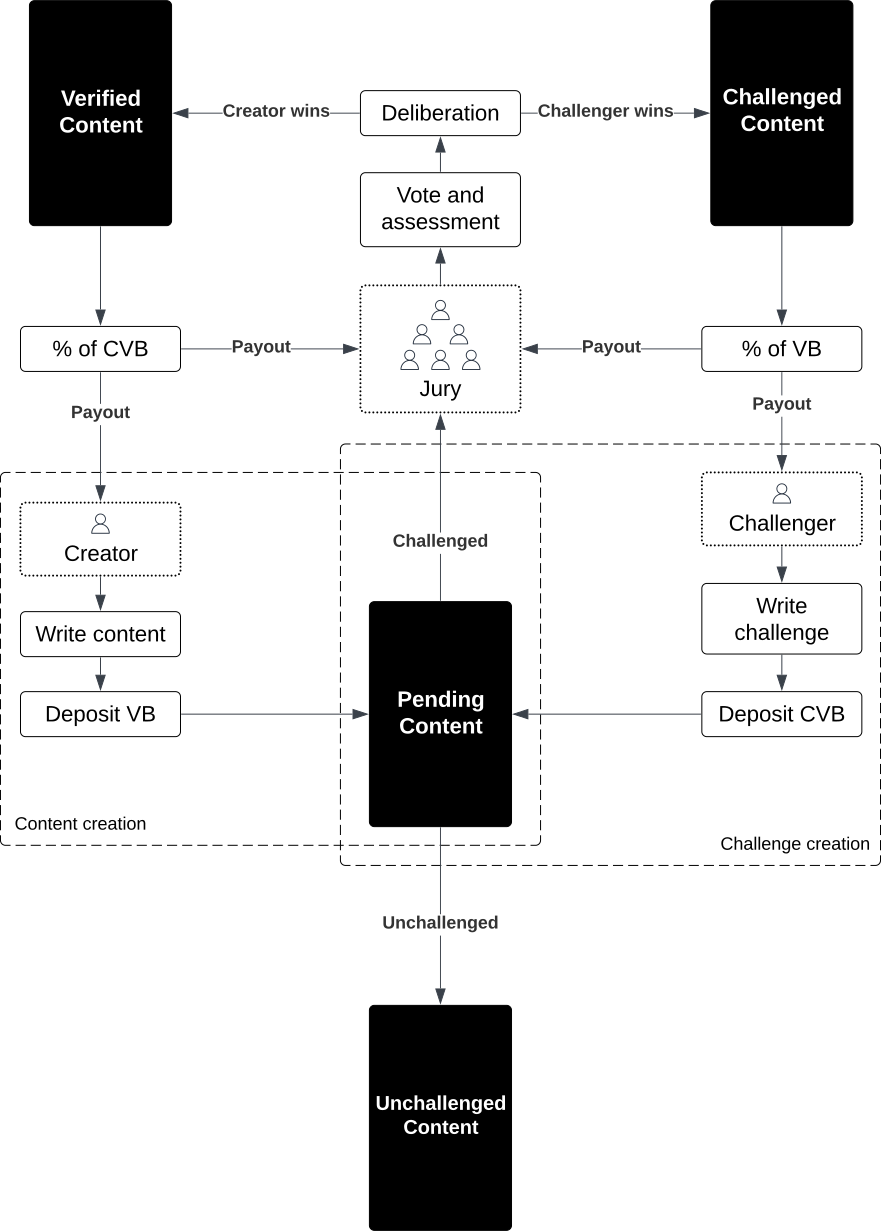
The proposed framework adds “trust” to the reward function for published content. A creator who makes a factual claim can stake a veracity bond, signaling confidence in the claim and accepting financial risk if the claim is later shown to be false. A reader who believes the content is inaccurate can become a challenger by staking an equal counter-veracity bond and submitting evidence.
A jury then evaluates the creator’s evidence and the challenger’s counterclaim. The losing side forfeits its bond, and the forfeited value is distributed to the winning party, participating jurors, and the protocol. This turns fact-checking from a purely reactive annotation layer into a contestable market mechanism.
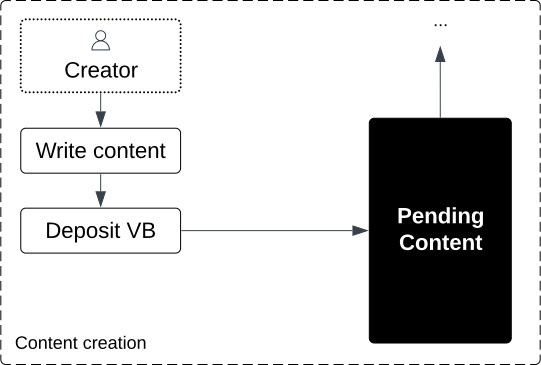
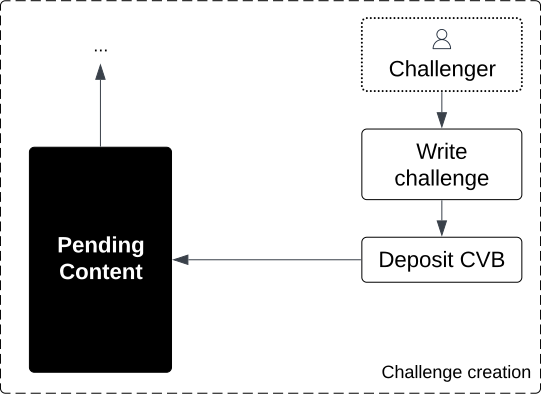
The mechanism makes claims contestable commitments: creators stake veracity bonds, while challengers stake matching counter-veracity bonds.
The model is intentionally exploratory. Its value is not that financial collateral alone can define truth, but that carefully designed incentives can make truth-seeking a visible, rewarded, and accountable activity inside digital media systems.
Roles
The framework separates the content-trust game into four roles. People may occupy more than one role in practice, but the model treats them separately to clarify incentives.
Creators
Publish content and may stake a veracity bond to signal confidence in factual claims.
Challengers
Contest a claim by submitting evidence and staking an equal counter-veracity bond.
Jurors
Review evidence, deliberate, vote, and provide written assessments that can affect reputation.
Viewers
Consume content and may help evaluate juror quality without joining the original dispute.
This role structure is meant to create accountability at every stage. Creators have “skin in the game” when making claims, challengers bear a cost for disputes, jurors are compensated for effort, and viewers help maintain the reputation layer that selects future jurors.
Vocabulary
- Veracity bond
- Financial collateral staked by creators to signal confidence in the truthfulness of their content.
- Counter-veracity bond
- Matching collateral staked by a challenger when disputing a creator’s content.
- Contest
- A structured dispute resolved by a jury after both sides stake bonds and submit evidence.
- Deliberation period
- The allotted time in which jurors review evidence, vote, and submit written assessments.
Mechanics
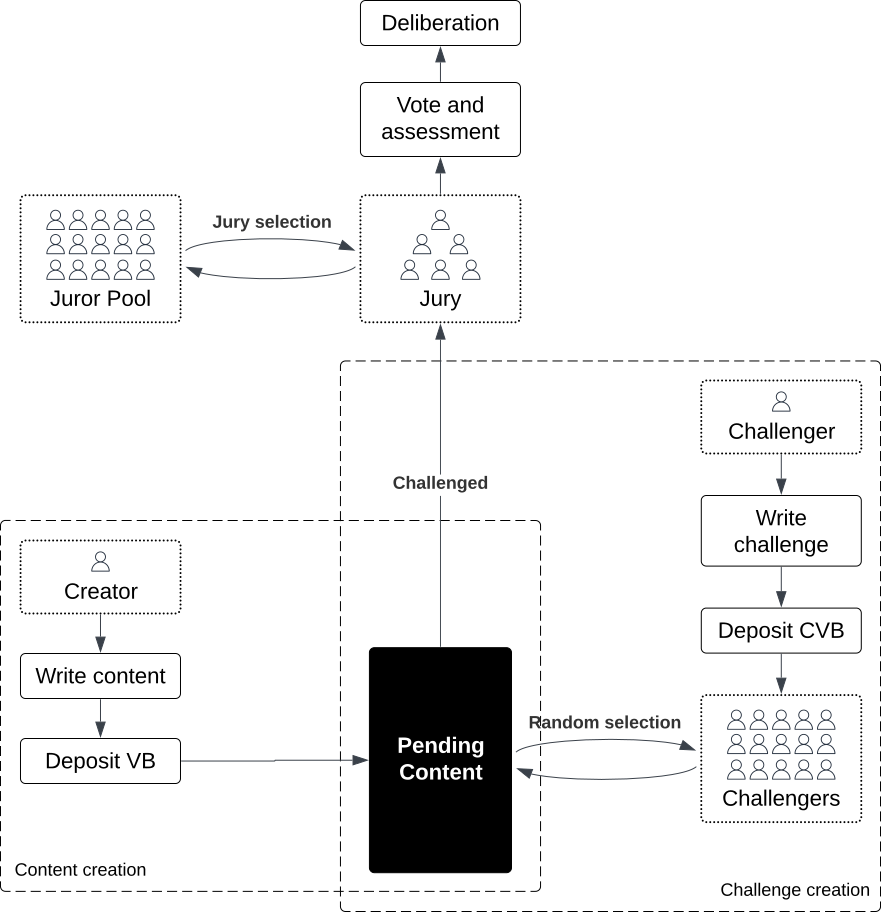
The content-trust process begins when a creator publishes a claim and stakes a veracity bond. During the challenge period, a challenger can dispute that claim only by staking a counter-veracity bond of the same value. Equal stakes are central to the mechanism because they prevent the jury from being economically tilted toward one side before evaluating the evidence.
If a challenge proceeds, an odd-numbered jury is selected from a larger pool of eligible jurors. The odd panel avoids deadlock by setting
where is the panel size and is the strict majority threshold. Jurors evaluate the evidence, vote for either the creator or the challenger, and submit written assessments. Once the verdict is finalized, the losing bond is redistributed.
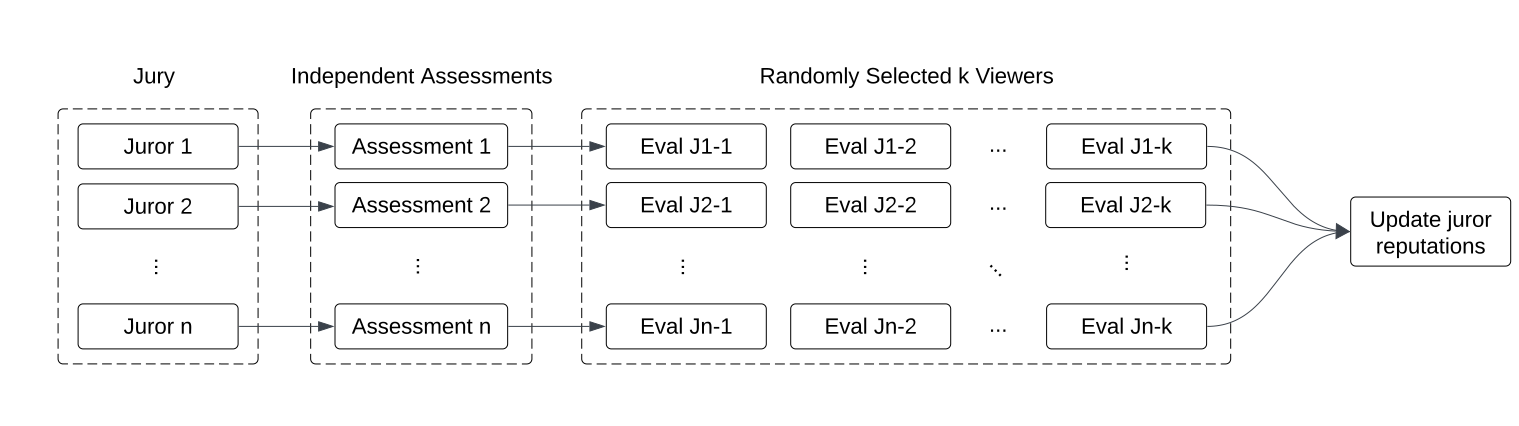
Juror quality is checked after the contest. Independent juror assessments are randomly assigned to selected viewers who do not have a conflict of interest. Their evaluations feed the juror reputation system and help identify low-effort or malicious participation.
The framework also supports sequential challenges. If multiple challengers contest the same content, only one proceeds at a time in randomized order. If the current challenger succeeds, remaining challenges are dismissed. If the challenge fails, the next challenger proceeds.
Incentive Model
Show me the incentives, and I’ll show you the outcome.
The payout model is grounded in the redistribution of a forfeited veracity bond or counter-veracity bond. When a contest ends, the losing party’s bond value is allocated to the winning creator or challenger, the participating jurors, and the protocol according to
Here, is the payout to the successful creator or challenger, is collective juror compensation, and is the protocol share. The paper frames this as a closed-loop incentive structure: rewards for accurate assessment are funded by penalties for inaccurate or poorly supported claims.
Reputation is the second layer. Jurors are not meant to maximize only money; they are also evaluated for diligence, evidence quality, and consistency. The paper models the benefit a juror receives from participating at level with monetary incentive as
Here, captures intrinsic value from prosocial participation, captures intrinsic value from monetary reward, and is the cost of the chosen level of effort.
The reputation payoff then makes the tradeoff explicit as
In this expression, is the visibility of the juror’s action, while and weight prosocial reputation against perceived monetary motivation. A good reputation increases the chance of being selected for future juries, while poor or self-interested participation reduces future opportunity.
Visibility is the third layer. Content backed by larger veracity bonds may receive stronger visual indicators or ranking weight, because a larger bond signals higher confidence and attracts more scrutiny. The paper notes the risk of “pay-to-win” dynamics, so the visibility mechanism must work with challenger incentives, juror review, and identity safeguards.
Trust Infrastructure
The framework depends on more than bonds. A content trust market is vulnerable if a malicious actor can cheaply create many accounts, flood juries, or manufacture fake reputation. The paper therefore treats digital identity as a foundational requirement.
At minimum, the system could combine email and phone verification, CAPTCHA, IP monitoring, and device fingerprinting. Stronger implementations may add voluntary government-issued ID verification or links to established social accounts. For long-term scale and privacy, the paper points to decentralized identity (DID) systems and W3C verifiable credentials as promising infrastructure.
Content provenance is the parallel requirement. Images, audio, video, and files should carry traceable evidence about origin, authenticity, and integrity where possible. Creators are encouraged to include provenance metadata with their claims, challengers should provide provenance for counter-evidence, and jurors should rely on that traceable history when evaluating authenticity.
Together, digital identity and provenance try to make two things harder: manipulating the people who decide truth claims, and manipulating the evidence those people inspect.
Guarantees And Limits
The paper includes a collusion-resistance argument for randomly selected odd-number juries. If a pool of jurors contains colluders, define and draw a panel of size . The panel reaches a verdict when at least jurors agree. With , Hoeffding’s inequality gives
The bound is useful because the probability of a successful collusion attempt falls exponentially as panel size increases, provided the dishonest share remains below one half.
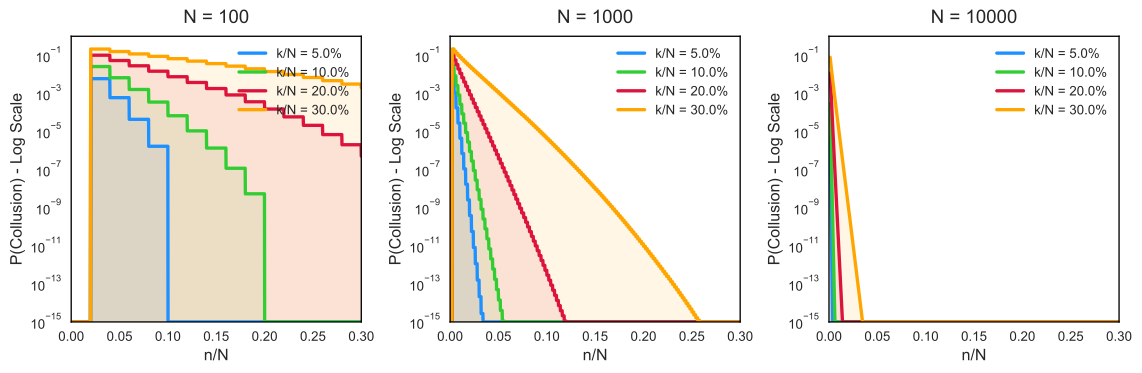
The numerical appendix turns that theorem into operating guidance. For a 10 percent corruption level, the exact hypergeometric tail probability is about at , about at , and below by . For a 20 percent corruption level, a panel of keeps the probability below in the table.
The appendix also analyzes juror capacity. If challenges arrive at rate , panels require jurors, each case takes expected active time , and each juror supplies active time , then the minimum pool size is
This turns scale into an operational planning problem: the needed juror pool grows with dispute volume and effort per case, and shrinks as available juror time increases.
Small community
33
Required jurors under the appendix’s standard staffing scenario.
Reddit scale
840
Required jurors in the same standard scenario.
Largest networks
10^6
The appendix’s largest estimates remain below one tenth of one percent of daily active users.
The limits are equally important. The model must still address creator adoption, integration into existing platforms, subjective and evolving claims, expert domains, concentration of power, bias in community consensus, appeals, privacy, and the danger that an unchallenged claim is mistaken for a proven one.
Open Questions
The paper closes by treating the framework as a research agenda rather than a finished protocol. Its open questions are not footnotes to the model; they are the places where an implementation would have to make hard choices.
The framework also needs policies for claims that remain unchallenged. Absence of a dispute may mean the claim is correct, but it may also mean no qualified challenger saw it, the claim was too trivial to contest, or the audience lacked the resources to evaluate it. Future implementations should make that uncertainty visible.
The paper’s most promising contribution is the shift in framing: trust is not only a label applied after publication. It can be designed as an incentive system in which creators, challengers, jurors, viewers, identity infrastructure, and provenance standards all participate.
Citation
If this work is useful in your research, please cite it as:
@misc{barbosa2025newincentivemodelcontenttrust,
title = {A New Incentive Model For Content Trust},
author = {Barbosa, Lucas and Kirshner, Sam and Kopel, Rob and Lim, Eric Tze Kuan and Pagram, Tom},
year = {2025},
eprint = {2507.09972},
archivePrefix = {arXiv},
primaryClass = {cs.GT},
doi = {10.48550/arXiv.2507.09972},
url = {https://arxiv.org/abs/2507.09972}
}